Fechar
CARLOS COBRA AN EXHIBiTION
MIRA Galerias | Espaço MIRA
Exposição
1.03—29.03.2025
Carlos Cobra belongs to an extraordinary generation of Portuguese artists who were Calouste Gulbenkian Foundation fellows in Paris during the 1960s and 1970s. Among these many artists, who for various reasons emigrated to Paris, were Lourdes Castro, Eduardo Luiz, René Bertholo, José Escada, António Dacosta, João Vieira, Costa Pinheiro, Jorge Martins and Júlio Pomar, amongst others. They would cross paths at exhibitions, at work, or in the famous studio of Vieira da Silva and Arpad Szenes in Montparnasse.
In the French capital, with the help of a scholarship, Cobra attended Henri-George Adam’s sculpture classes at the École des Beaux-Arts and began studying the techniques of welded iron and casting at the Académie du Feu with the Hungarian sculptor László Szabó. Étienne Hajdú, who worked with Estremoz marble in many of his works, would also go on to mentor several of his pieces. In 1967, he took part in the Paris Biennale and, in 1971, in the group exhibition 10 ans d’art portugaise, which Joaquim Veríssimo Serrão, then director of the Centre Culturel Portugais, dedicated to the scholarship holders in Paris. In 1981, he received the Prix Bourdelle, the most important prize in European sculpture, the only time it has been awarded to a Portuguese artist, with the museum exhibiting his works.
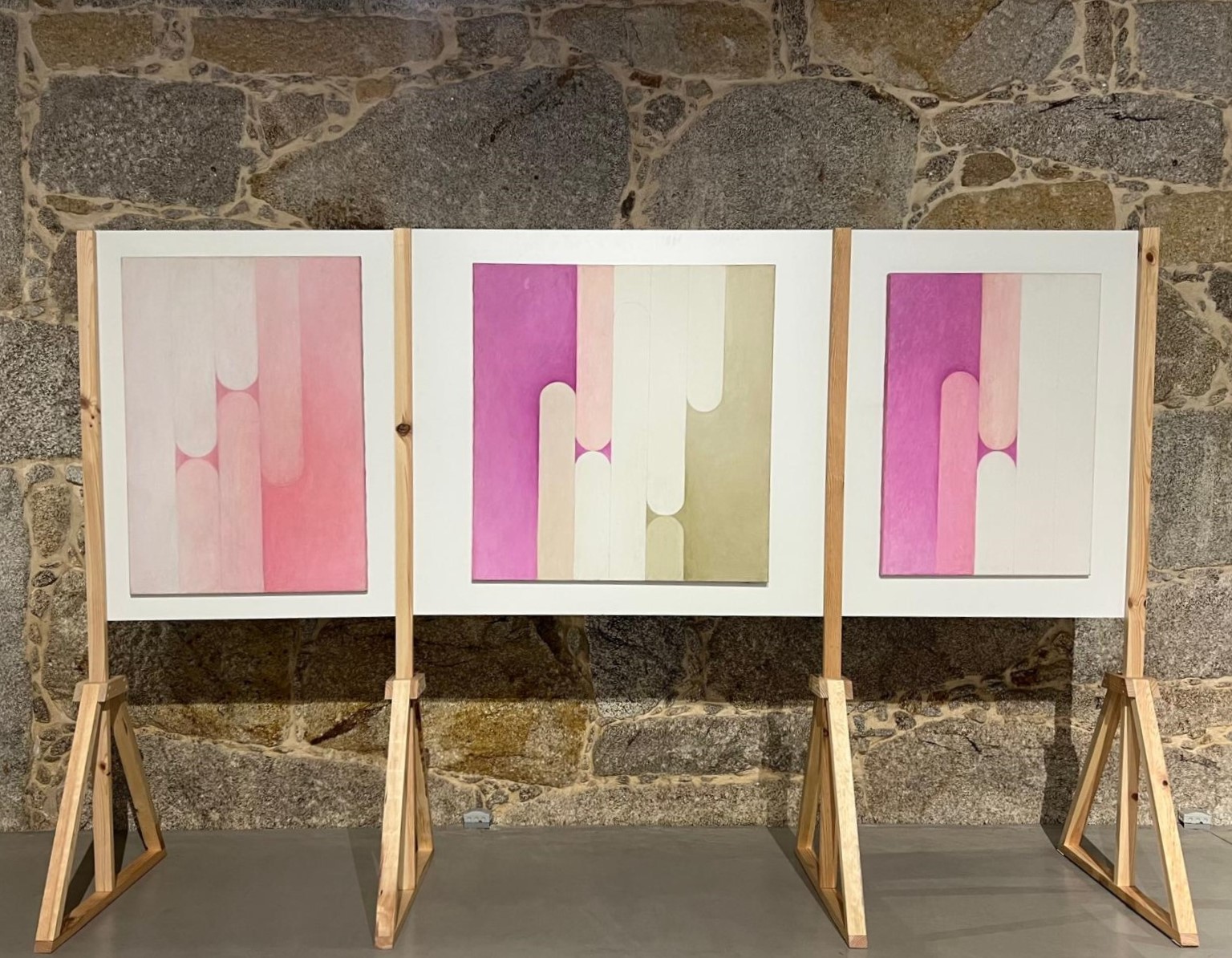
Following an exhibition—the only one, to our knowledge, of works on paper—some five decades ago, organised by Laura Soutinho at the Cooperativa Árvore, we can now finally see, here in Portugal, a new showcase of Carlos Cobra’s work, in this exhibition which brings together some twenty-five previously unseen paintings from recent years, and a beautiful and rare sculpture from 1960. Which emerge upon us with such vehemence in the silence (words borrowed from Herberto Helder in Photomaton & Vox), and a secret strength, far from the clamour of the world, and which remain vulnerably as a sudden memory for some. Accompanying the exhibition is a screening of a conversation between Carlos Cobra, Paulo Branco—who met him in Paris in the early 1970s and has remained friends with him ever since—and the director and screenwriter Carlos Saboga, who met Cobra whilst still in Portugal and also went into exile in Paris at the time, where, like Cobra, he still lives and works.
Cobra speaks to us of Paris and his artistic work, of art and literature, of the artists with whom he lived, offering us an extremely rich perspective on an era and a generation that were fundamental to Portuguese art.
From the early 1980s onwards, Cobra began to devote himself more to painting, and continues to work every day. And in the conversation we mentioned, he says: A painting is constructed through a dialogue between the painter and the canvas. The painting suggests things that we may or may not accept, and the painter suggests other things that the painting may or may not accept. It is this dialogue that is a long one. And he adds: An interesting thing about painting is that it allows you to correct the past. I find myself correcting paintings I made 50 or 60 years ago. Sometimes I fetch a painting and touch it up. Doing this sort of thing is a bit like the work of an alchemist. The essence of the alchemist’s nature lies in repeating the same symbolic processes every day. Every day he repeats the same operation with chemicals that possess a symbolism, and that operation is a kind of prayer that nourishes the spirit. And painting is a bit like that for me. Concluding later: No one has ever seen these paintings. This is the first time I am going to show them. That these paintings of mine will be seen.
Curated by Paulo Branco
Text by António Costa
Organised and produced by LEFFEST
Set design by Renato Costa and Marina Vismara
CREDITS
Directed by Manuela Matos Monteiro and João Lafuente
Artistic Director: Manuel Santos Maia
Assistente: Rita Ferreira Costa
Biographical Note
Sculptor and painter. Born in 1940 in Alcácer do Sal, Carlos Cobra was, like many artists of his time, a student at the Lisbon School of Decorative Arts (now the António Arroio School of Art). In the early 1960s, he travelled to Paris (where he still lives and works) on a sculpture scholarship from the Gulbenkian Foundation. In 1967, he took part in the Paris Biennale and, in 1981, received the Prix Bourdelle, the most prestigious sculpture prize in Europe. However, his work is virtually unknown in Portugal.
This exhibition is the second in a series of exhibitions dedicated to the artist, which opened at MUDE in Lisbon, organised by LEFFEST, in November 2024. MIRA Galerias | Espaço MIRA presents a selection of 25 untitled paintings, created between 2014 and 2020, alongside a sculpture from 1960.