Fechar
FREEDOM HAS NOT YET ARRIVED
Group Exhibition
MIRA Galerias | Espaço MIRA
Exposição
13.04—18.05.2024
Today we are opening the annual exhibition dedicated to 25 April at Espaço MIRA in Campanhã, following in the footsteps of its predecessors. Because at MIRA, April is always celebrated, not just on commemorative dates.
Come and explore these exhibition sections that provoke our thinking: we have powerful words such as indigenous, race, imperialist, dictator, sex, teacher, invasion, inaction, people. We have many more, organised into small sections linked by enduring images (palm tree, plate, flag, poster, television, carnation).
Manuel Santos Maia and Rafael Prado introduce the first section. In the first case (the alter-ego of the exhibition’s curator, José Maia), we are faced with a set of hand-painted panels, where the military dictatorship and the Estado Novo, in a sense, inherit the cultural heritage of the monarchy and the liberal republic—the imperialist colonial legacy. What is presented here may be difficult to grasp, but perhaps that is why it needs to be shown again: the paintings appropriate titles from newspapers and articles, reflecting the colonising process that conceptually frames this section of the exhibition. These phrases are not imagined; they were used in an instrumentalisation of the white man’s perceived duty to colonise and evangelise peoples foreign to them. There is also the concept of racial status, which permits discrimination against the inhabitants of the colonies. The consequences of this are far more severe than the racial concept itself; they include forced labour and the expropriation of land, driven by a logic of exterminating native resistance. The status of indigenous people since 1926 (military dictatorship) has had specific objectives: to discriminate, racially, socially and culturally, against indigenous individuals and their peers, and to compel them into forced labour in public works, cotton and diamond companies, amongst others. These companies were able to make use of these resources, with the support of the authorities. Portugal is said to have maintained this status until much later than other colonising nations.
Rafael Prado (Br.) has been undertaking an artist-in-residence programme in the city of Porto and presents a piece that evokes a flag, or a processional banner (used to open ceremonial events), which in Portuguese and Brazilian cultures carries the dual and simultaneous connotations of both celebration and mourning.
“Estandarte” (2024) represents the dream of saving an indigenous tribe,
through the metaphor of an indigenous woman who dies and transforms into cassava, a plant that feeds her people, which does not truly die, because it transforms into seed, into life.
In the second section, we are confronted with the importance of historical documentation, combined with cultural memory. Inês Coelho displays a symbolic object, a small-scale sculpture, with a certain irony associated with the figure of the soldier it seeks to represent. Before it, black-and-white photographs developed by hand using a darkroom, in a traditional process, highlighting the disconnect between the images produced and the moment we are living in, where everything is so instantaneous and fleeting.
At the heart of the documentation and persistence of archetypal images, the palm trees in João Salgueiro Batista’s photographs engage in a dialogue with those of Sérgio Leitão. Palm trees are visual elements very typical of the large gardens of Porto, particularly those that belonged to estates of families who remained in Brazil or Africa, and who brought them back with them. In this sense, we can say that, although they are very familiar to us, we know they are imposed on the specific urban landscape of Porto and its surroundings, and are imperialist symbols per se.
For Sérgio Leitão, it is important to remember and celebrate Cesariny, a sur-realist who turns to assemblage, a liberating and experimental medium, representative of someone who always tried to go against the norm. In three distinct installations, words taken from poems by Mário Cesariny are represented. Both artists speak of freedom, yet they address many anxieties, oppressions and repressions, and in particular the importance of memory for contemporary history and the fear of forgetting.
In “Unidos” by Felícia Teixeira, João Brojo and João Campolargo Teixeira, Miguel Torga’s words reflect the idea of the collective, of the people, who always unite in the face of the power asserted by the future, even if it means development that destroys the collective. The damaging scars of mining work are forgotten by the local population, who assert their freedom in the public square through graffiti on the wall. Is this a piece about revolution or about resilience?
The cylinders, one of which features a carnation, by Susana Chiocca, with red tones without actually being red, are in some way phallic, dynamic, and perhaps oppressive? The gold tones, which evoke flame and fire, lead us to the cylindrical pipes of the unarmed revolution, whose power we have forgotten. The playful aspect of this piece, attributed almost entirely to the abstract nature of its interpretation (which is very open-ended), is reinforced by the freedom of movement it affords us, suggesting different vantage points, and is in some way clarified by the title “The days we live in or the weapons of my body”.
1 And it is only when we speak to citizens of other countries about our 25 April that we realise just how extraordinary this event was considered to be throughout the world, and that it is a positive example of revolution in the 20th century;
Set against the gallery space is the interactive installation by Carlos Trancoso and Marco Duarte, who invite the visitor to participate, revealing, through photographs of dictators, other images that are initially hidden, containing a sexual nature and explicit content. One can play with it; the images are never the same, and the intention is to explore the different ways of interpreting the piece.
It should be emphasised that “PopPorn” (2023) is, above all, an archive, produced through the archival impulse of artists who do not want the world to forget, because every detail counts. For future memory, because memory prevents us from repeating the same mistakes.
Pedro Pousada creates a digital image from three drawings, in which he references Lenin, a teacher, and Jeff Koons, a speaker, with all the cultural liberalism, also in a classroom, with his back turned to the right, in a profound symbolism that assumes that images do indeed hold power. In the two or three things we know about a revolution, based on historical images produced by an artist-teacher, the impact of the teacher’s figure of authority is no accident, in the way this constitutes a social portrait: what it means to speak to the masses, to the people, if they are willing to listen.
On display is the piece “Washing dishes as a family #1-#11” (2024) by Diogo Nogueira, in which the artist has devoted himself to revealing pictorial episodes relating to his own personal history, through a medium that contrasts with the large-scale painting with which he usually works, whilst at the same time referencing classical paintings that served as a means of education. In line with the work of Pedro Moreira, where ceramics remain a key element, this piece, for its part, presents a language far more vibrant than ceramics typically allow, approaching a certain cinematic characterisation, almost suggesting props for a gore film.
The exhibition concludes with an installation by the CDQ collective, and a tile panel by Duarte Águas, complementing the installation. Taking as its starting point a real-life space in a parish of the municipality of Maia—a roundabout with a fountain—the collective carried out a temporary occupation, transforming the space into a work of art, inhabiting it as if it were a public swimming pool, thereby reinforcing the ironic significance of the roundabout’s artwork (something deeply characteristic of the north of the country). On the second day of the intervention, they were interrupted by the police, officially ending the work (the performance), thereby enabling the creation of the archive of the work presented here. By turning a roundabout into a real place, this piece creates an interventionist movement across several different layers.
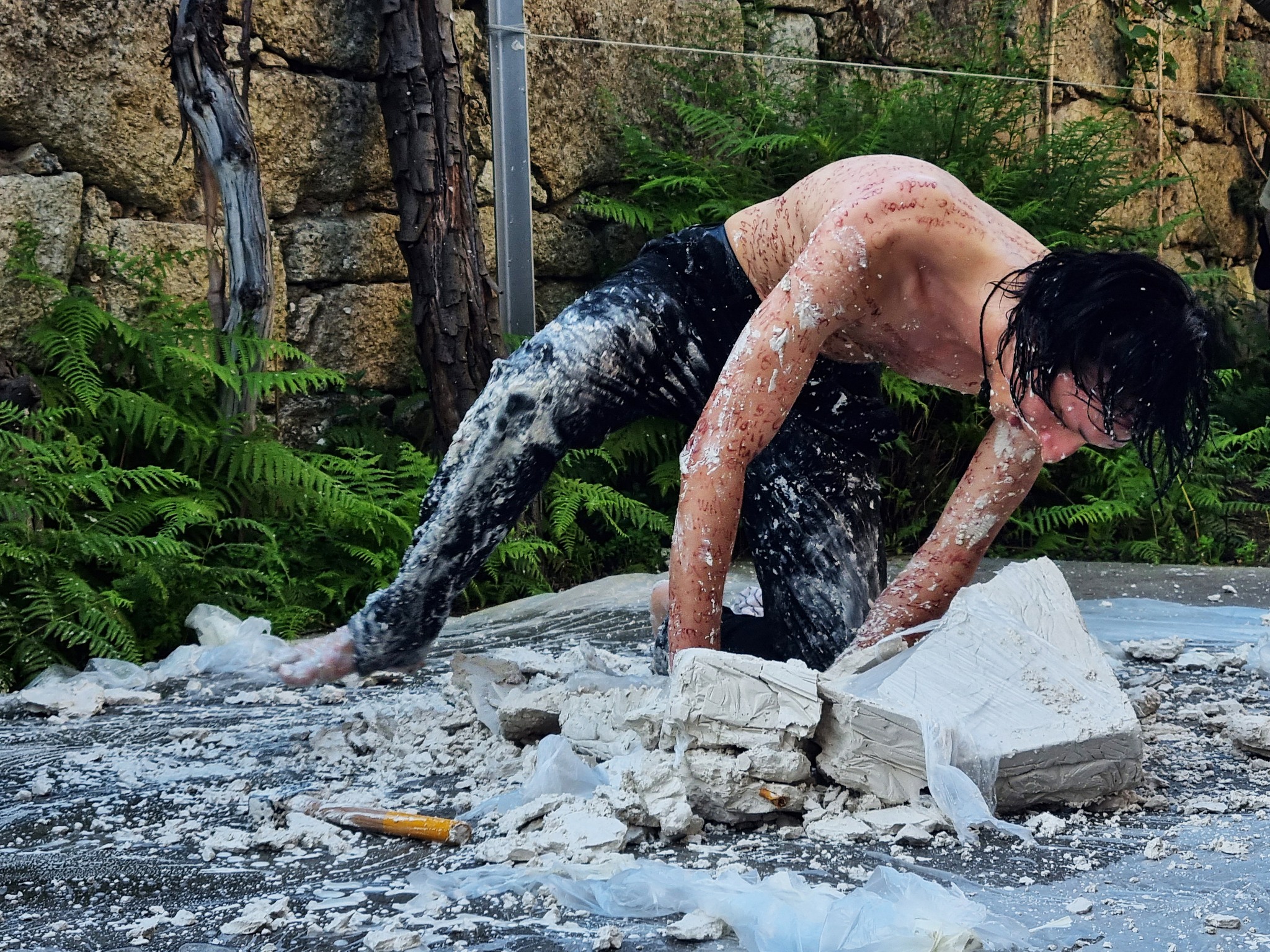
António Lago presents performances inspired by the figure of Gisberta, reading aloud the phrases written on plates that are smashed, symbolising the destruction and rebirth that April represents. Nuno Fareleira and Afonso Loureiro present another performance in which the destruction of a cube reveals unexpected contents.
The exhibition continues with a programme of guided tours that bring it to life and make it as intense as the season suggests. May April come, and may it come for everyone.
Joana Mendonça