Fechar
LINKING THE MOUTH TO THINGS
Recoletora
MIRA Galerias | MIRA FORUM
Exposição
15.06—27.07.2024
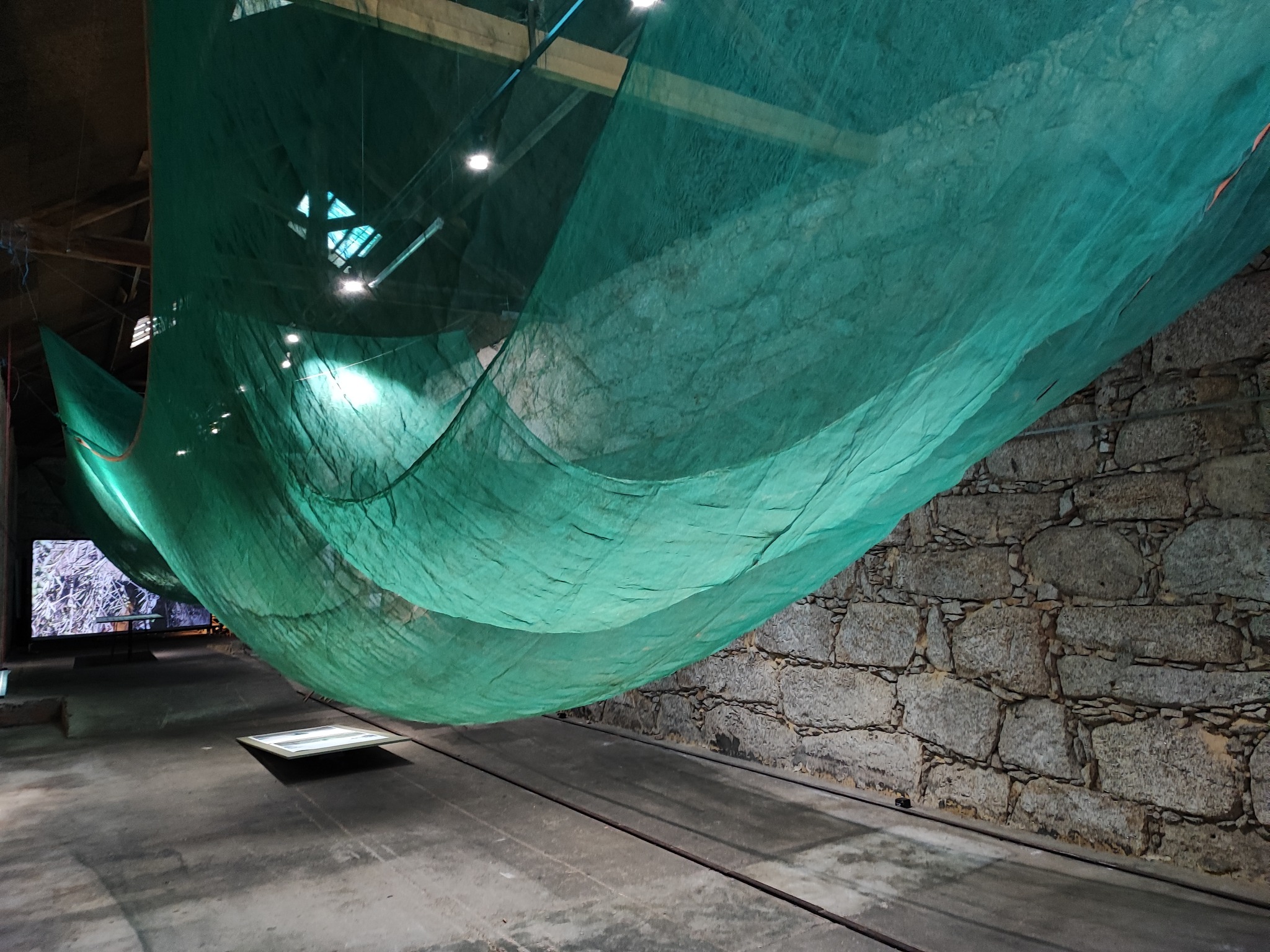
SHADOW OF A MANTA
By João Terras
Wherever we look, at the centre of it all, lies a field of olive trees. In this gallery, there is a single olive tree. There is an old man raising his arm and striking the tree, there is the weariness in his hand and the wound on the sole, that sort of swelling we see in the image, the result of the blows to the branches. There is the wineskin and the winter’s chill. There is the swing of a blow, there are the leaves fluttering, there are the olives falling to the ground. There is that unimaginable osmosis of the dead fruit into the olive oil. There is the mythology from the moment we became beings until we placed our faith where this plant and this food have become one. That is why, at the centre of all this, lies the murmur of it all.
Every December, or towards the end of the year, those who already live there and those who are making their way there gather in the village of Lagoa, in Trás-os-Montes, Portugal. There is no deeper romance than thinking about what might lie beyond the hills. A primitive and scenic fetish that we idealise with foreboding, what lies beyond the mountains has always intrigued us. The caves could not have been anywhere other than in the mountains; the springs, the waterfalls, the forests, the peaks—all of this lies beyond, behind the mountains.
Like anyone else who, every December, travelled to Lagoa, Alexandre Delmar recorded what he would call “acts”—Act I, Act II, various acts over the course of several years. He went on to draft a possible heteroclite historiography based on parallel narratives, tales, myths, and that which takes shape in the place of formless things. In that which constitutes coded languages, in that which is known within a community, and in the things that stem from the power of intuition and instinct. History from within the mouth and speech, connections between human and animal, human and plant, plant and animal, animal and spiritual, human and spiritual, gravitations that reverberate in practices, in doings, and which, through synapses, become established in customs.
But an act, even if embedded in a possible arrhythmic and insubordinate choreography that Alexandre attempts to construct intuitively, even if it is an act of this possible historiography of the formless, an act is still a form, a concrete thing, a part, a division or a potential action of something. Therefore, if at the centre of this gallery lies everything we spoke of at the beginning—this which he called acts—they were never acts, they never were, and today they will be even less so.
It will be a figure, an omnipresence, with even greater force, a ghost. All of this will ultimately be a story of figures, of something that exists inexplicably amongst all things and spaces.
And here we arrive at a possible answer to what he has been doing all along, the condition of the artist merging with the condition of the collective, where Alexandre Delmar and Maria Ruivo merge, and all those who gravitate around this parallel story that is A Recoletora.
The image transforming into food, the mouth in conversation, a place even more diffuse and intertwined in this other construction of another place.
The power of the image, whether from the camera, film, sound, object, written tale or drawing, has always lain in the attempt to find a record for the ghost, to record that figure, that impossibility, that unifying and indefinable soul that united body, action and space.
This, which we might call the history of the figures, as opposed to the history of things, and which extends from Lagoa to other places, lies in the osmosis of the olive into olive oil, lies in the hands of the people who live and carry out this work of removing the fruit from the tree, lies in the spider’s web that traces the same shape as the scar on the blanket, lies in the silence of the trees and the wandering animals. It is here now.
A tree does not become a genius by chance; it possesses that genius, that soul. That is why we shall remain until the end, and without end, writing a possible story of something that
does not have the human at its centre.
As we walk through this cobbled tunnel of the gallery, we follow the rhythm of the installation: first figure, mantis-figure; second figure, mantis-fruit; third figure, fruit-tree; fourth figure, mountain-figure.
This larger figure dominates the entire centre, that centre where everything is. That mantis that will return to the mountain.
Finally, the silence, the bait, the artist’s transhumance from river to mountain, from fisherman to shepherd, the silence of the man atop that rock gazing at the wild river and what lies beyond the mountains. Everyone speaks of the tragedy.
We hear the rumour that, in one of its past lives, the gallery space was once a factory. Boaproa – Portuguese Fishing Net Factory.
GROUND, EARTH AND PEOPLE
The exhibition Enlaçar a boca às coisas forms part of the “Ground, Earth and People” cycle, alongside the exhibitions As Guardiãs das Sementes by Vanessa Ribeiro-Rodrigues and A Fundo na Paisagem dos Landra, which open on the same day, 15 June, at 4 pm, at the MIRA FORUM.
These exhibitions run until 27 July.
The cycle continues with two conferences, video screenings, other exhibitions and events until November.
This cycle takes place as part of the Em Liberdade project, supported by RPAC | Portuguese Contemporary Art Network, and involves, in addition to MIRA FORUM, three venues in other parts of the country: Colégio das Artes (Coimbra), AiR 351 (Cascais) and Lugar do Desenho (Gondomar).
MIRA FORUM
Direction | Manuela Matos Monteiro and João Lafuente
Assistant | Luísa Rosas da Silva
Biographical Note
RECOLETORA is the collaborative practice of visual artist Alexandre Delmar (1982) and designer Maria Ruivo (1986), dedicated to the study of points of reciprocity and interaction between human and plant communities. In their work, the duo combines ongoing research, inventorying and mapping of wild edible and medicinal plants with the revival of ancestral and contemporary knowledge, within an educational and artistic framework that proposes a rediscovery of the city through foraging and wandering through urban wastelands and the built landscape.
A Recoletora brings together botanists, nutritionists, chefs, artists and designers on a collaborative and itinerant platform, which aims to explore themes related to food sovereignty, foraging, herbalism, traditional know-how, oral traditions and ethnobotany, promoting participatory activities such as mapping, walks, workshops, shared meals, exhibitions and publications. Alexandre and Maria have been collaborating since 2013, but it is from 2021 onwards that they have been signing their joint work under the name A Recoletora. Notable works include: ‘Meter o chão à boca’ for the Galeria Municipal do Porto (2022), ‘Na fronteira da horta, a comida marginal’ at the invitation of curator Andreia Garcia, at the CIAJG in Guimarães (2022), ‘O lodo ensina a dançar’ for Maia Architecture Month (2023), A pele vegetal da cidade for the Porto Museum (2023–24) and A emergência da raiz for the group exhibition “Un rastro de furia e algas” in Santiago de Compostela