Fechar
THE CART’S ROUTE
Group exhibition
MIRA Galerias | MIRA FORUM
Exposição
20.06—13.09.2025
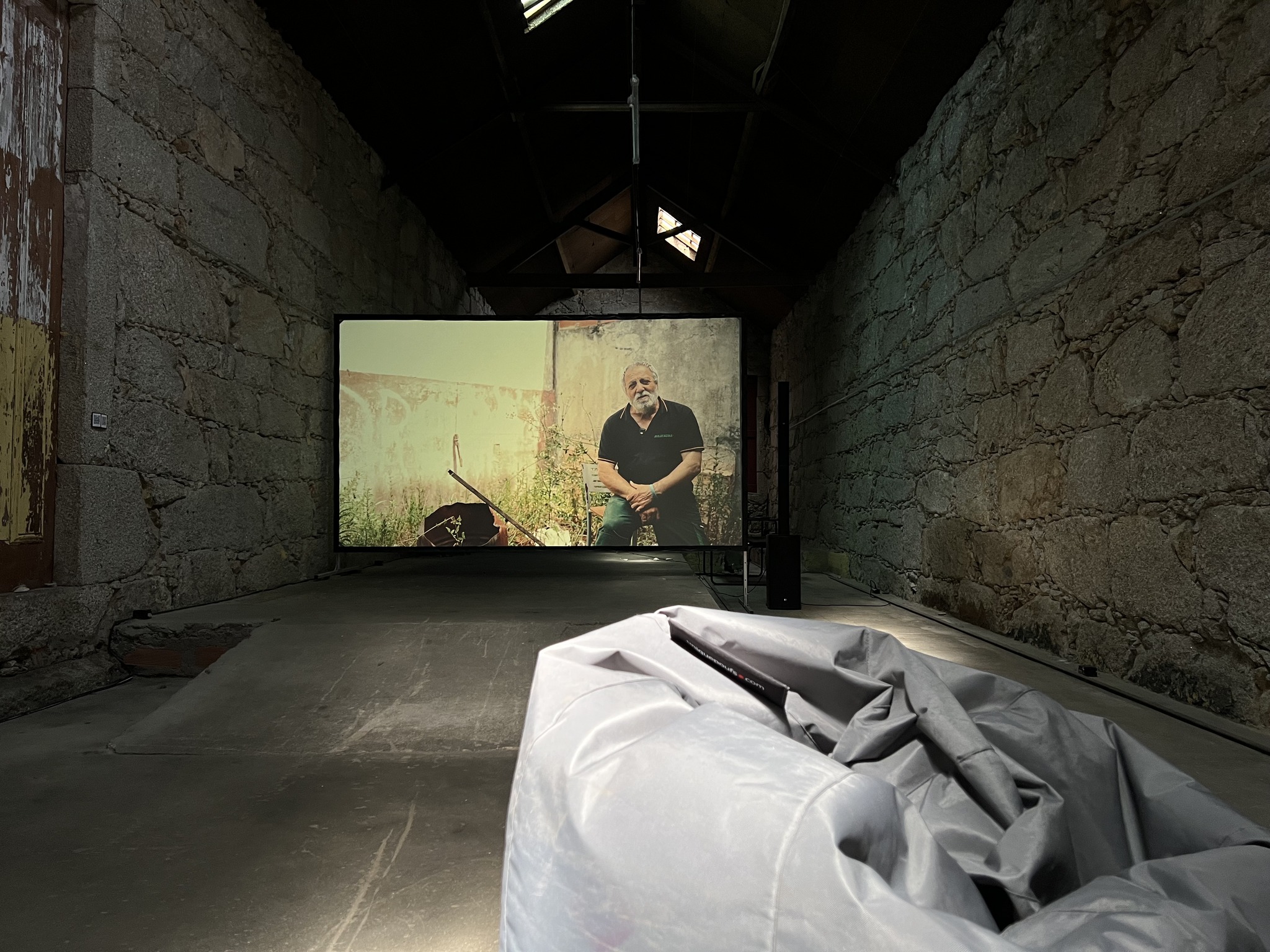
We met Mr Manuel when we arrived in Miraflor, almost 12 years ago. Ever since, we’ve seen him leave the warehouse in the morning with an empty cart, go down the street, turn at Broas e Broinhas and head up Padre António Vieira Street. The trolley knows the route by heart: it turns onto Heroísmo, goes on and on, passes the stop sign, the cemetery, and makes its first stop at the florists, the most colourful and fragrant spots on its route. The circuit is like a round of visits to all the little shops: the butcher’s, the Chinese shop, the greengrocers, the frozen food shop, as well as the restaurants and cafés. The regular residents, who already know his routine and times, leave their neatly stacked cardboard at the door, which makes collection easier. The return journey is the route in reverse, but he takes Miraflor Street to get back because it’s all downhill.
The trolley is heavy, and with every passing year it gets heavier. At the warehouse, it’s time to unpack the boxes and sort the cardboard into the right piles – the ones that cause the least hassle. Mr Manuel knows all its nooks and crannies; he squeezes it, creases it and fills the boxes, which are then lifted and delivered to Valongo. The final destination is China, because in Portugal processing this material is more expensive than using wood.
Since 2015, the warehouse has been a venue for performances and installations by various artists who, out of curiosity, peek in, step inside and see possibilities they cannot find anywhere else. In this project, we welcome artists who use cardboard in their work—where cardboard is the material that gives shape to the creative project—or who reference it, or else summon it to express themselves in many ways.
The musician and composer Jorge Queijo saw in the cardboard boxes and scrap metal an expanded drum kit within the warehouse space, whilst Susana Chiocca retraced part of Mr Manuel’s daily route, crossing this experience with the one she undertook in Luanda, “Globula”, by Ana Deus and Paulo Ansiães Monteiro (PAM), combines a sphere made of cardboard and paper onto which a video, “Made in China”, is projected. Without intending to be a strictly documentary record, Manuela Matos Monteiro presents photographs of Mr Manuel along the route, in the act of collecting and folding the cardboard, giving prominence to the materials piled up in the warehouse.
Around 300 digitised protest posters from the EPHEMERA Archive bear witness to the voices that find in cardboard a means of communication. Teresa Pacheco Miranda recounts this Cardboard Route in a documentary video made in May and June of this year.
Mr Manuel will be the city’s only cardboard collector, which means this activity is set to disappear. This exhibition preserves the memory of a practice and also of a street, extending, in a way, the “Emotional Map of Miraflor” project.
We are in Miraflor, living, showing, telling, intertwining artistic practice with the community that considers us one of their own.
And we are!
Credits
MIRA Galerias | MIRA FORUM
Directed by Manuela Matos Monteiro and João Lafuente
Communication by Manuela Matos Monteiro and Beatriz Vital
Assistant: Beatriz Vital