Fechar
NO ONE’S FEMININE
By Ana Pérez-Quiroga | Beatriz Teixeira | Joana Patrão | Rita Castanheira | Rafaela Lima
MIRA Galerias | Espaço MIRA
Exposição
24.02—5.04.2025
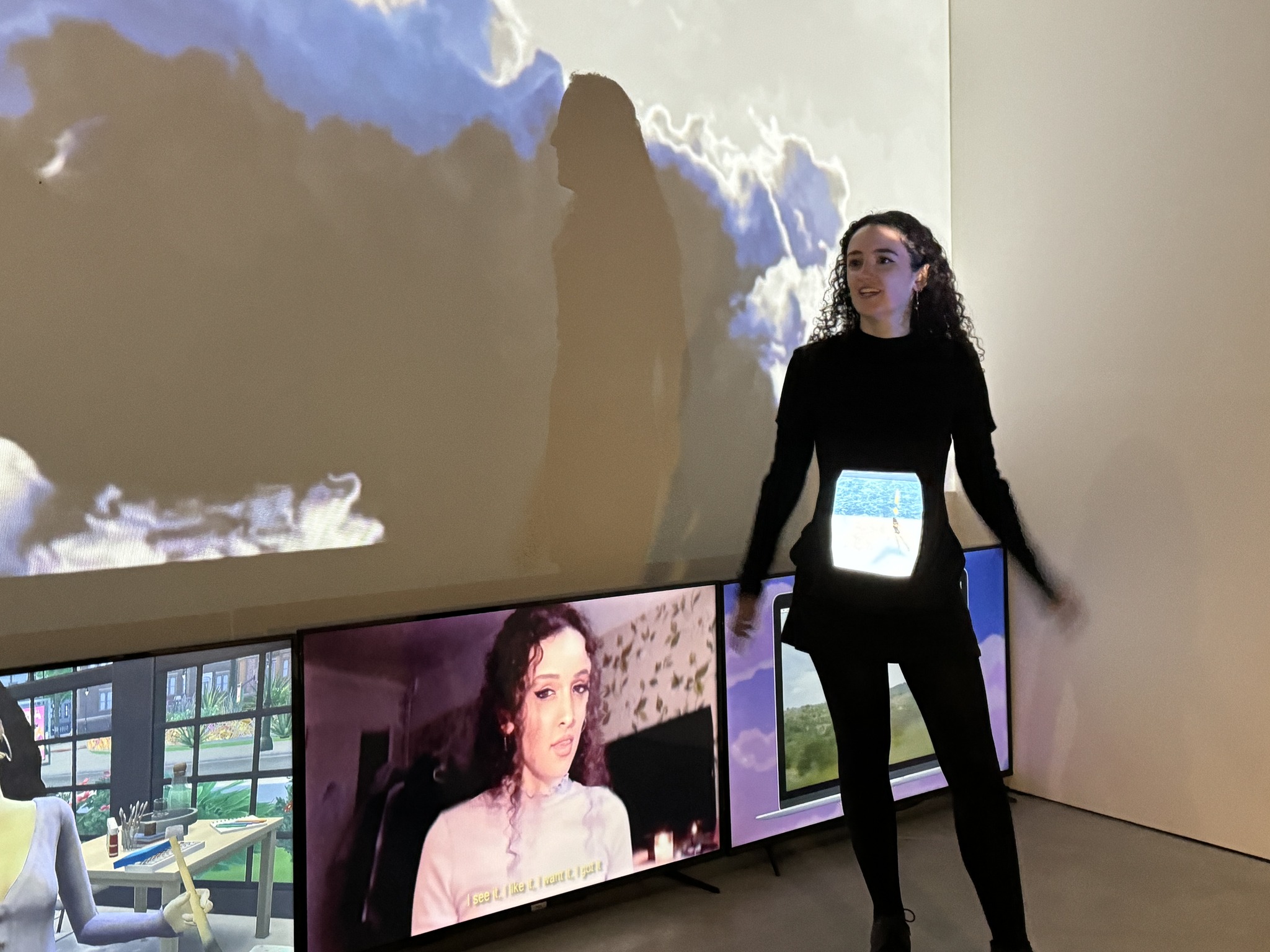
We enter the first warehouse in Miraflor to discover *No One’s Feminine*, an apt title drawn from a work by Maria Gabriela Llansol—a literary reference frequently cited by curator Manuel Santos Maia, not only for the powerful way the phrase is used, but also for what it implies in terms of the expectation of change in the world.
Through the convergence of painting, sculpture, photography, video, installation, artist’s publications and even performance, we can say that this exhibition deals with transformation, but also with the immutable, the absolute and the visceral.
The first work we encounter is Ana Pérez-Quiroga’s *Absolut taste of diversity - Shanghai* (2013), composed of various elements of coloured silk, somewhere between the aesthetics of a flag and the scenography of theatrical spaces; it refers to her research into the daily life of an artist, from her personal home to her travels and the objects she has accumulated over the years.
This piece by Quiroga creates a particular rhythm, subdivides the space organically, bridges the generations separating these artists, and makes us reflect on the expression “belonging to no one” that is everywhere (see the gallery’s footnotes). The space is, therefore, collective, sharing notions of the here and now, utilising entirely distinct methodologies to do so.
However, Ana Pérez-Quiroga sets the initial – what I would call slow – pace of the exhibition visit, through her interpretation of the iconic gardens depicted in painting, but this time using large wool fabrics. It may not be immediately apparent, but there is something very familiar about this first garden, with its suggestion of a picnic, a place of rest or contemplation. Here, an invitation is extended to a sensory understanding of the exhibition, which unfolds as we make our way through the gallery.
We might say that Beatriz Teixeira finds herself in a limbo between a strong technological presence (or the plasma screen on the floor presenting the graphic image of her own exhibition), combined with the possibility of making something with our own hands, aware of the time it entails, and of the that arise from it: Beatriz Teixeira revisits the Inércia project, which is dedicated to investigating the limits of design as a practice historically dependent on an employer, and its capacity to persist when such a commission does not exist. Her work is therefore difficult to define – where it begins and ends – due to its graphic presence, the handwritten title of the exhibition, and her strong determination to create a sense of unity. There is also an autobiographical quality that prompts us to ask questions, if only of ourselves.
Rafaela Lima presents works from the project ‘From Zero to Five Thousand Feet’, which is a research project dedicated to documenting a flight she did not take. The fear of flying is one of the most absolute fears, shared by the youngest children and the most robust and experienced adults, bringing to mind the work of the Bulgarian artist Nedko Solakov who, for years, travelled by plane with pieces of clay that became the reliquaries of his journeys. These lasting imprints of the artist’s hands served as a form of catharsis, a means of self-control that he eventually abandoned when, at a certain point in his career, he decided to stop flying, turning down invitations to exhibitions abroad and thereby limiting his own artistic trajectory. Rafaela stands on the opposite side of the narrative, her artistic journey still in its infancy, choosing to devise a credible exhibition structure by photographing the aeroplanes at the Castro Verde Aero Club, thereby enabling the creation of a possible story—her own history of aviation. The piece is completed by an installation which, through the play of light, explores the illusion of whether we are facing something real or imaginary.
Continuing the tour of the gallery, Rita Castanheira represents a generation of artists who allow technology to become an ally (in her case, even more than an ally); on the other hand, she is also very interested in learning new practices, such as embroidery and sewing. With a more leisurely visit to her section, we realise that craftsmanship is far more present than it appeared at first glance. What is curious is that for Rita Castanheira, the “new practices” she has been learning are as ancient as can be (as our grandmothers would say). And they can even be considered feminine practices, though that is a provocation I shall leave here.
Rita explores the cacophonous side that inhabits the limbo of her generation; the avatar that allows us to be wherever we want (and in several places at once) is here transported in a literal sense: we understand her working process through a simulation of the workspace. Her personal computer desktop is in fact the setting for a video conceived for this game of hide-and-seek. From her research into popular computer games that allow character customisation, she selects scenes and excerpts related to pop artists and Japanese aesthetics: she superimposes her face, does karaoke, uses TikTok filters, lets us read her WhatsApp conversations (or does she?). We are always seeing her, even if we do not realise it. Regarding the videos shown on multiple screens, she states, “these ones will still give rise to something else, something longer, in the future”, suggesting that we are witnessing her working process, her thought process, and at the same time the possibility of seeing there a collective, an entire generation.
We conclude the narrative journey with Joana Patrão’s work, perhaps the most methodical of the pieces presented here, due to the way they systematise artistic processes. “How to draw the sea” refers to an ongoing project, which began as an obsessive exercise in drawing one sea a day, using the lines of the sea’s movement. Knowing that this type of drawing followed the same process—that is, the next line always related to the previous one—Joana Patrão initiated a new drawing methodology for the piece presented here, installed on the floor in the form of an artist’s book. Here, the sea is no longer a prisoner of its first line; rather, it responds to a poetic proposition: “I am not referring to its appearances, but to the passage of time, to its fluidity, to its alternation”. During this process, Joana meticulously gathers the information the sea provides her, ranging from the most sensory elements to the analytical lines she constructs in diagrams over the images, which she then uses at a later stage.
In this way, by creating a system of distancing from the model, the drawing ceases to be one, becoming instead a means of measuring the circumstances that lead us here, and of creating a completely autonomous piece that can be interpreted in multiple ways.
“The drawing thus emerges as a way of writing time” and of giving us the freedom to feel it, if we so wish.
As we visit the exhibition, we sense a strong presence that is not visible, that of the references brought by the artists and the curator. If, for Maria Gabriela Llansol, the feminine belongs to no one in particular, but rather to everyone, then this is the freedom of feeling that the exhibition affords us: the certainty that there are certainties in the themes addressed here, such as home, daily life, fears, repetition, and the technological absoluteness of the times in which we live.
But there is also room for the public to make their own decisions: what do the sky and the sea mean, why the colour and the landscape? Where do these questions lead us? Perhaps to ask even more questions.
Joana Mendonça