Fechar
THINGS WE INHABIT, THINGS THAT RAVE
By Carla Castiajo
MIRA Galerias | Espaço MIRA
Exposição
25.01—22.02.2025
Shortly afterwards, the world’s madness was unleashed.1
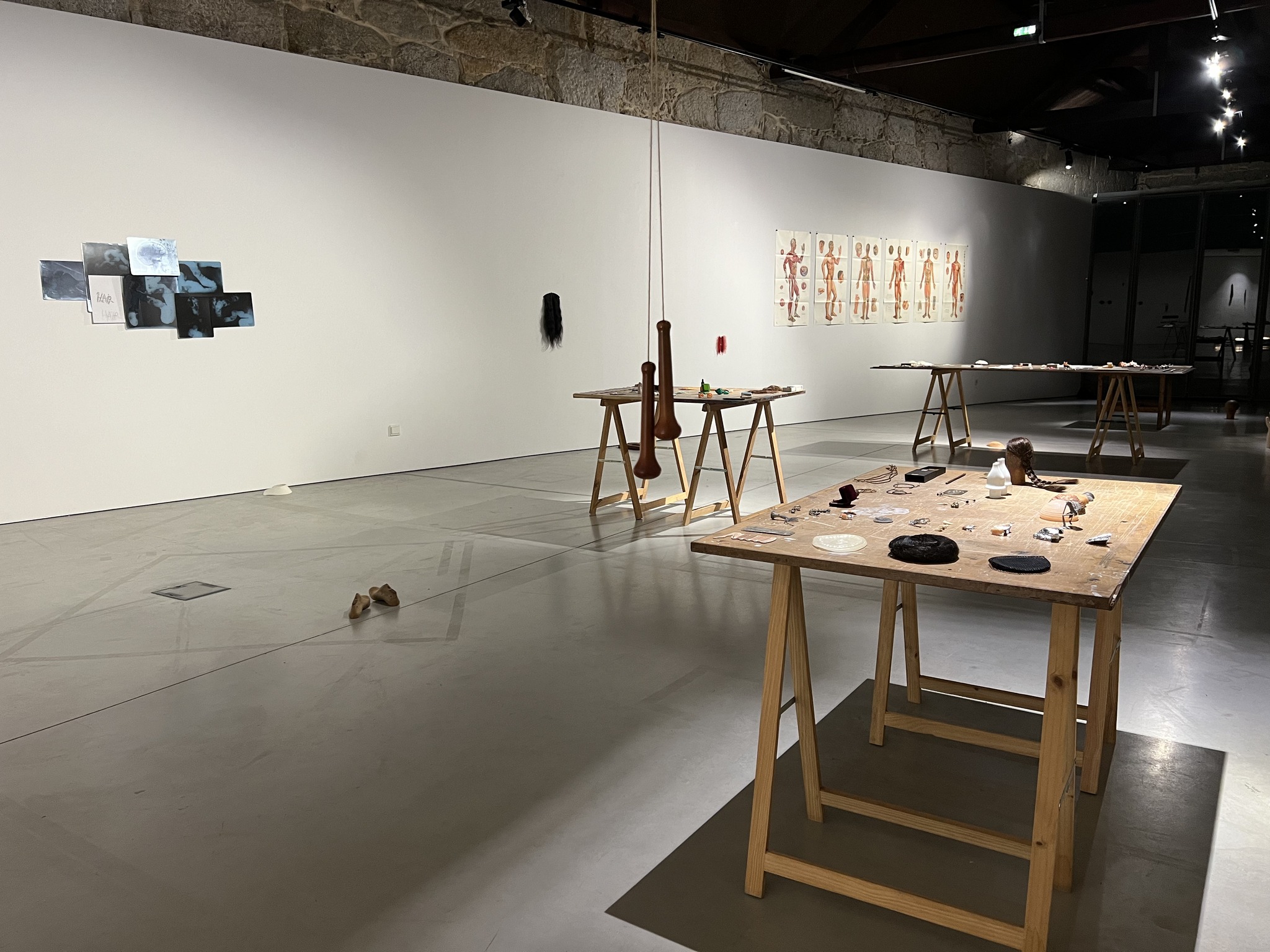
Only the silence where everything converges. Illusion and fantasy summon memory and a passion for detail. Things unfold in indeterminate ways — with no boundaries between interior and exterior, the particular and the universal, matter and spirit, objects and ideas. Frames and mirrors influence and contradict one another — without limits. Lines and hair. The splendour of the ‘we’ or the Deleuzian ‘fourth person’ that awakens in this exhibition. Between wood and glass, metal and fabric, paper and language, each thing becomes a multitude that now draws us in, now pushes us away. Suspended on threads of silk, hair and cotton, in the form of pins or wooden frames, the dense and light, opaque and transparent things reveal themselves as remnants offering themselves in their finitude — what is a thing, asked Heidegger? How to speak of it? We seek what others do not wish to know. We persist in time and in what exists.
Feet and hands, shoes and gloves, jewellery boxes, hangers and hooks, wigs, dolls and mirrors — living natures given to us through the necessary relationship established between oblivion and the horizon of pleasure. Worn-out presences feature in the sovereign arrangement of stories whose anatomy is immobilised in the mystery of circumstances. In the realm of things, it is the invisibility of bodies that suggests theatricality and renders it luminous in space, evoking the forms and images which, in their materiality, open up to the surface, to distance, to consistency or to fragility. The gaze draws near and recedes, torn by intention or accident. A sidelong glance, like that of one condemned to flee from a poetics of touch. An imaginary extension of the stage machinery is what things seem to embody — the adventure of, unlike Ecclesiastes, chasing the wind.
Artistic practice, transformed into the art of the phantom and the real, ensures materiality and the senses, bodies both absent and present, finitude in the poverty of things. In this mode of being of existences, in which radical imperfection enshrines the great Nietzschean health, we accompany ourselves and find the possibility of inhabiting the vast cosmos. In the words of Joseph Brodsky — An object is what makes infinity private. To inhabit delusions openly and to disrupt the names that immobilise things is what an exhibition can still accomplish.
(1) Maurice Blanchot — A Loucura do dia. Lisbon: Edições Sr. Teste, 2020, p. 8.
Eduarda Neves
Programme
25 January, 4pm
Exhibition opening
15 February, 5pm
Performance, activation of the installation by Maria João Costa Espinho
(the author does not follow the new spelling rules)
1 Maurice Blanchot — A Loucura do dia. Lisbon: Edições Sr. Teste, 2020, p. 8.
Acknowledgements:
ESAP, Isabel Castiajo, Israel Matos, Marco Ferreira
Exhibition open from 25 January to 22 February 2025
Wednesday to Saturday, 3pm to 7pm
CREDITS
Directed by Manuela Matos Monteiro and João Lafuente
Artistic Director Manuel Santos Maia
Gallery Assistant Luísa Rosas da Silva
Intern Rita Ferreira Costa
Biographical Note
Carla Castiajo uses human hair, pubic hair and other organic elements as her primary materials in the creation of objects for the body or that allude to the body. Recently, she has also been using textiles, particularly traditional Portuguese embroidery, in the construction of her work.
She crosses different artistic fields and employs various techniques, drawing on everyday objects and/or references to the objects that surround her – the domestic, the private, the intimate, the ordinary, the mundane, moments of daily life... Her creations reveal a tension between opposites, such as attraction/repulsion, public/private, sacred/profane or life/death. In a constant reflection on finitude as a vital force, the whole of human nature is recorded daily, repeatedly...